UWT MSCS
Program Features
UWT has cheap tuition and a flexible CPT policy -- you can co-op twice, just like UW EE PMP. UWT also has a capstone. Suitable as a safety choice for students with low GPAs but rich internship experience who are ready to go all in on job hunting in the US, or students who just want to grind LeetCode and completely coast through classes.
You can write UW MSCS on your resume, which is great. Someone on Reddit shared that as a UWT MSCS graduate, they wrote UW MSCS on their resume, interviewed for hundreds of interviews, and nobody ever asked about the difference between UWT and UWS -- literally zero people care. UWT has tracks in DS, Cybersecurity, Distributed Systems, Cyber-Physical Systems, Bioinformatics, and GIS. If you want to go all in on SDE, choose the Distributed Systems track. Tacoma is about 51 km from Seattle. Cost of living is lower than Seattle, with nearby supermarkets (Asian Market, Walmart, Target) -- you can meet basic daily needs even without a car. The campus is small and relatively plain compared to the Seattle campus, lacking some of that modern feel, but the beach is less than 10 minutes away with nice views.
Homework and exam pressure is relatively light, giving students more time for LeetCode grinding and internship preparation. The Master's CS program (MSCSS) offers three study modes: Course Only (45 credits), Capstone Project (40 credits), and Thesis (40 credits). Most people choose Course Only since it's faster to graduate and easier to earn the degree. Generally it takes 4-5 quarters to complete, with total tuition around $50K. You can take courses at the Seattle campus, but registration priority is low -- popular courses are often full, and commuting isn't very convenient either.
Tuition is about $12,000 per quarter, with graduation in 4-5 quarters for a total of approximately $50,000. Tacoma rent is $1,200-1,800/month (depending on whether you have roommates). Cooking for yourself costs about $400/month. Initial furniture and mattress purchases can mostly be handled at IKEA and Walmart for a budget of about $1,000.
Job Outcomes & Data Points
UWT's CPT policy is very flexible -- after completing 3 full-time quarters, you can start interning. Internships can be full-time or part-time and count as a course that can be taken twice, meaning you can do summer + 2 co-ops at most, which is excellent. Many people have ample time to prepare for interviews and internships. According to UWT undergrad students, each year there are roughly 10 Amazon placements, and Google + Meta combined have about 5. Considering UWT's small class size, the student quality it attracts, and the fact that it's never a top-5 choice for Chinese students, these numbers represent strong "low entry, high output" outcomes.
-
UW Japanese Studies undergrad, UWT MSCS master's, landed small company new grad
-
Indian student, one year full-time experience, landed Tesla intern
-
Indian student, four years full-time experience, landed small company new grad
-
UW undergrad, zero internships, landed Google new grad
-
Electrical, electronics and communications engineering undergraduate in India, full-time at Hitachi Energy before the master’s, SWE intern at a small company during it, then Amazon SDE full-time after graduating in 2025.
Admission Threshold & Data Points
Average admitted GPA is 3.5. TOEFL requirement is relatively low at 92 to apply. Overall preference for 985 university applicants with lower GPAs. Career changers need to complete prerequisites. Some students from Tsinghua and Peking University attend.
- International student, GPA 3.7
- US undergrad, GPA 3.26, 6 years full-time at Microsoft
- International student, GPA 3.5, GRE 321
- US undergrad, GPA 3.72, one year of research experience, no publications
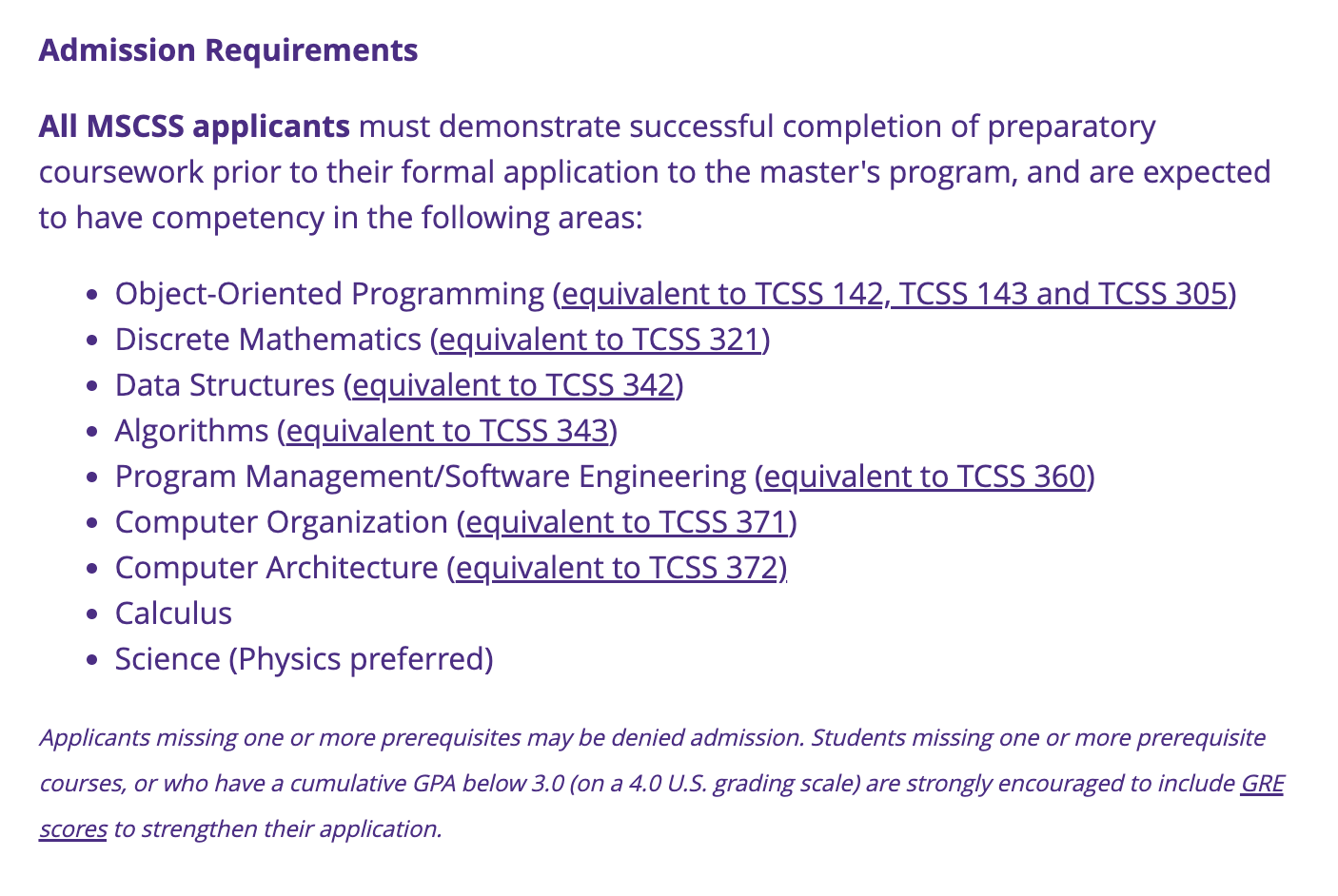
Prerequisite requirements are as follows:
UWT vs UWB Comparison
| Dimension | UW Bothell MSCSSE | UW Tacoma MSCSS | Comparison |
|---|---|---|---|
| Location | ~20-40 min drive from Seattle, near Microsoft HQ, some Amazon offices, Google, etc. | ~45-60 min from Seattle, 1+ hour from the Eastside | Bothell is better |
| Official Employment Data | 90.3% of graduates employed at or within 6 months of graduation (official data: uwb.edu/stem/graduate/mscsse/careers) | No specific public master's-level percentage data, but the website claims graduates go to Microsoft, Amazon, Google, etc. (uwt.edu has no detailed report) | Bothell is better |
| Target Companies & Recruiting Access | Closer to Eastside tech giants; recruiters visit Bothell more often; evening classes + working-professional-friendly, conducive to working while studying (common path: intern -> full-time) | Graduates also get into big tech, but requires more self-motivation | Bothell is better |
| Resume Screen | Write "University of Washington MS in Computer Science & Software Engineering" -- HR basically doesn't differentiate campuses, all recognized as UW | Write "University of Washington MS in Computer Science & Systems" -- equally recognized as UW | Tie |
| Overall Employment Competitiveness | For most people wanting to get into Seattle big tech (Amazon, Microsoft, Google, etc.), it has more advantages (90.3% employment rate + location edge) | If you prefer cybersecurity/data science/systems, or prioritize budget/cost of living, you can still find good jobs, but on average requires more LeetCode/projects/self-driven effort | Bothell is more recommended |
| Approximate Rent | Bothell rent is relatively higher -- studio ~$1,775-$2,100/month, 1BR ~$2,400+/month, 2BR+ up to $3,000+ (average ~$2.2K-$2.4K) | Tacoma rent is lower -- studio ~$1,250+/month, 1BR ~$1,784+/month, 2BR ~$2,200+/month, average ~$1.4K-$1.6K | Tacoma is cheaper |
Conclusion: Apply to both. For job-hunting focus, go UWB. For budget control, go UWT.